
Unequal Impacts, Unequal Power: Understanding Gender Dimensions of Climate Justice
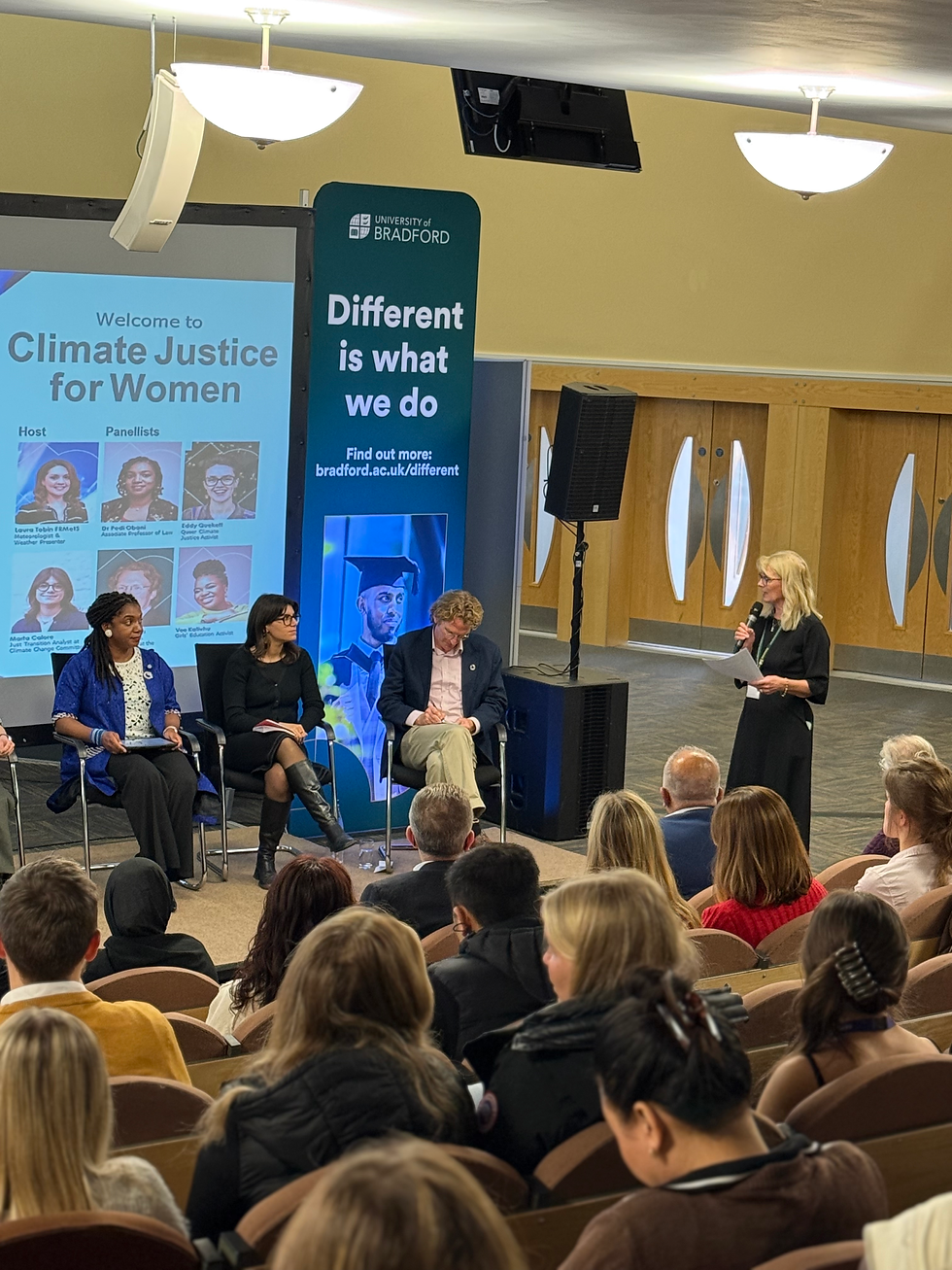
At the University of Bradford’s “Climate Justice for Women” event, experts called for urgent, gender-responsive action to make climate justice real for everyone.
Last week, the University of Bradford welcomed a passionate and diverse audience to Climate Justice for Women, one of its flagship Bradford 2025 City of Culture events. The gathering brought together researchers, policymakers, students, and activists to explore how climate change impacts women differently and why gender must remain central to the global conversation on justice and sustainability.
The response from the panellists was clear: climate change is not gender neutral. It worsens existing inequalities, affects women the most, especially those already facing poverty and exclusion and calls for a new, inclusive model of climate governance.
“Climate justice for women is not a favour; it is a right,” said Dr Pedi Obani, Associate Professor of Law and Principal Investigator of the UKRI-funded Gender Inclusive Climate Change Governance (GenCGov) project. “Our research shows that women are already leading, innovating, resisting and surviving. What they need now is access to power, to protection, and to platforms like this.”
A call to see climate justice through a gender lens
Opening the event, Professor Shirley Congdon, Vice-Chancellor of the University of Bradford, situated the discussion within the university’s broader mission of inclusion and impact.
“Bradford is proud to host world-class research that truly matters to people,” she said. “Too many still live in the shadow of deprivation. We can’t fix everything, but we can choose to make a difference where it counts, and climate justice for women is one of those places.”
For Dr Obani, that difference begins with listening. Her four-year GenCGov Fellowship, spanning the UK, Nigeria, Kenya, and South Africa, examines how women’s lived experiences can reshape climate law and governance. From flooded city streets in Benin to energy poverty in northern England, her research aims to highlight the everyday realities often overlooked in top-down policy debates.
“We build what I call citizen evidence-grounded knowledge that complements policy and law with lived wisdom,” she explained. “If we dare to listen and respond, we can make real change.”
“The climate crisis is here and it’s personal”
Television meteorologist and climate advocate Laura Tobin made the science vivid, reminding the audience that the impacts of global warming are already observable and profoundly human.
“We talk about the climate crisis as if it’s somewhere far away or far in the future,” she said.
“But it’s happening right now. The storms, the floods, the droughts, they’re here, and they’re changing lives.”
Reflecting on her journey in the male-dominated worlds of science and media, Tobin called for increased visibility of women in STEM and climate leadership. “We can’t solve the climate crisis if half the population is left out of the conversation,” she noted.
Her message resonated with Vee Kativhu, UN Young Leader and education advocate, who urged educators to embed climate and social-justice literacy into schools:
“We’re inheriting this planet, yet young people are too often left out of the decisions. We’re already leading; what we need now is to be heard and equipped to act.”
Intersectionality, policy and the path forward
Other speakers highlighted how the fight for climate justice must include all marginalised communities, from women in low-income households to queer and disabled people disproportionately affected by extreme weather and exclusionary policies.
Eddie O’Connell, a climate-inclusion advocate, underlined the importance of recognising overlapping inequalities: “If we don’t understand how race, class, disability and gender interact, we’ll keep building solutions that leave people behind.”
Marta Gomez, from the UK Climate Change Committee, echoed that sentiment, describing fairness and participation as non-negotiable principles for effective policy. “When we analyse climate impacts, we have to ask: are we widening inequalities or closing them? Real progress only happens when every voice counts,” she said.
Determined, not defeated
As the discussion turned to hope, the message was one of determination rather than despair.
“Whether in Bradford or Benin, women are already creating change,” said Dr Obani. “They are transforming care into activism and resilience into leadership. What they need are laws and institutions that recognise them, protect them, and value their knowledge.”
By the end of the event, audience polling showed a significant increase in optimism compared to the beginning of the session. One attendee quoted environmental scholar Rebecca Willis:
“Maybe the better question isn’t whether we’re optimistic or pessimistic. It’s whether we’re determined, and today, we are.”
About the programme
The Gender Inclusive Climate Change Governance (GenCGov) project, led by Dr Pedi Obani, is supported by the UK Research and Innovation Future Leaders Fellowship. The research brings together partners from the UK, Nigeria, Kenya, and South Africa to develop gender-responsive frameworks for climate law and governance. The Climate Justice for Women event is part of GenCGov’s broader goal to connect academic research with public engagement and real-world impact.


Comments